The Path to Newton (an online Interactive Exploration)
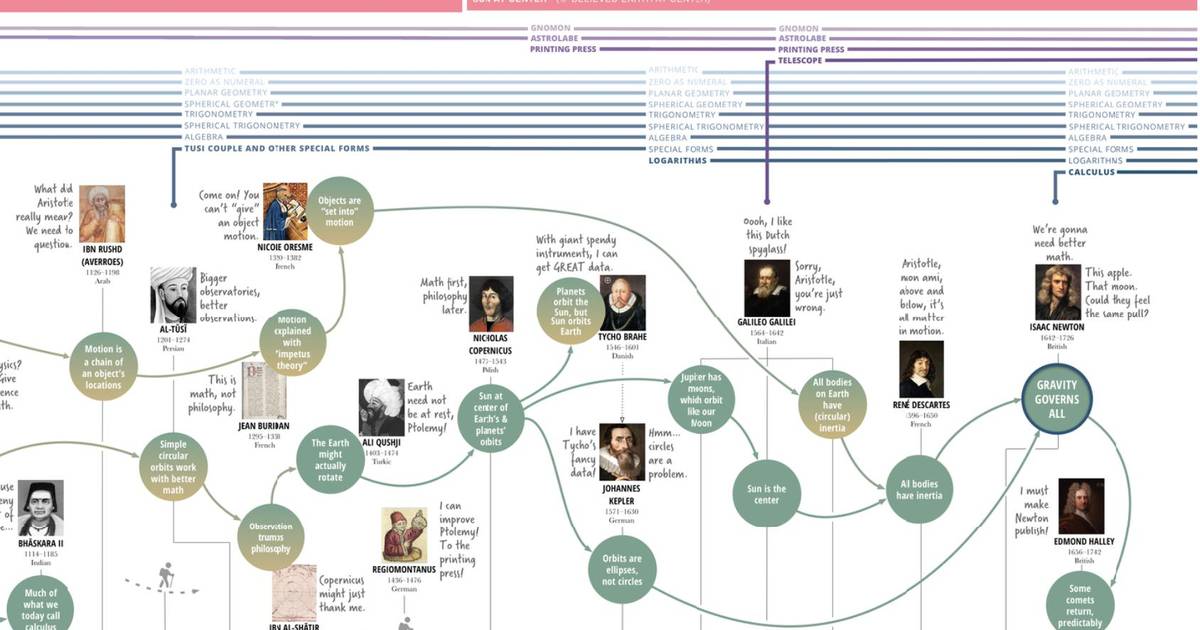
This interactive timeline explores the philosophical and mathematical conceptions of the Universe and of how and why objects move on Earth, in order to explain how an ultimately unified theory of motion came to be.
Topics
- velocity
- sidereal
- mass
- momentum
- motive force
- parallax
- geocentrism
- heliocentrism
- impetus
- inertia
- cosmogony
- acceleration
- aether
- Edmond Halley
- force
- motion
- Principia Mathematica
- Isaac Newton
- Descartes
- Newton
- Principles of Philosophy
- René Descartes
- Discourses and Mathematical Demonstrations Relating to Two New Sciences
- Sidereus Nuncius
- Starry Messenger
- Copernicus
- Brahe
- Kepler
- Galileo Galilei
- Galileo
- Mysterium Cosmographicum
- Johannes Kepler
- Tycho Brahe
- Nicolaus Copernicus
- Regiomontanus
- Ali Qushji
- Nicole Oresme
- Ibn al-Shāṭir
- Jean Buridan
- Tadhkira fi'ilm al-hay'a
- Memoir on Astronomy
- Nasir al-Din al-Tusi
- Alfonsine Tables
- Ibn Rushd
- Bhāskara II
- Ibn Sina
- Kitab al-Manazir
- Book of Optics
- Ibn al-Haytham
- Al-Battani
- Brāhmasphutasiddhānta
- Brahmagupta
- Surya
- Romaka
- Paulisa
- Vasistha
- Paitamaha
- Varahamihira
- John Philoponus
- Aryabhata
- Ptolemy
- Euclid
- Hipparchus
- Aristarchus
- Aristotelian physics
- Plato
- Exodus
- Aristotle
- Anaxagoras
- Democritus
- Parmenides
- spherical geometry
- celestial movement
- Pythagorean theorem
- universe
- unified theory
- Pythagoras
- Thales
- Anaximander
- Babylonians
- star
- catalog