Understanding X-Ray Crystallography Structures
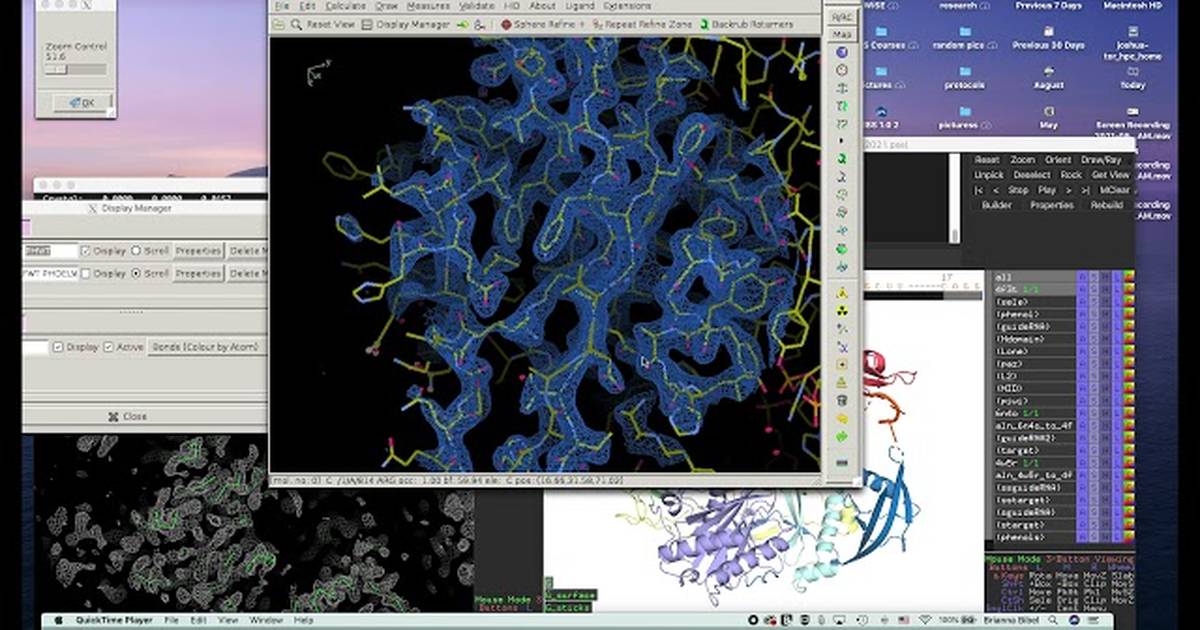
X-ray crystallography is a technique where we look at protein (or other molecules') atomic structures (where the different individual carbons, nitrogens, oxygens, etc. are) by beaming x-rays at crystals of those molecules. The x-rays get scattered from the atoms' electrons and the scattered rays interact, combining together in certain situations to give strong waves. We can then capture those "diffracted" x-rays on a detector and work backwards from the pattern of spots (diffraction pattern) to find the positions of the electrons that caused the scattering. And then we can build an atomic model into that electron density map. And then do a lot of iterative refinement trying to get the model and map to fit. In this video, I go over the basics of x-ray crystallography models & maps, and what you're actually admiring when you "get lost" in a good structure in a PyMol or Coot... Some theory and practical info towards the end on how you can play around for yourself.
Topics
- lab techniques
- protein structure
- x-ray crystallography
- atomic structures