Seeing Specific Heat and Latent Heat
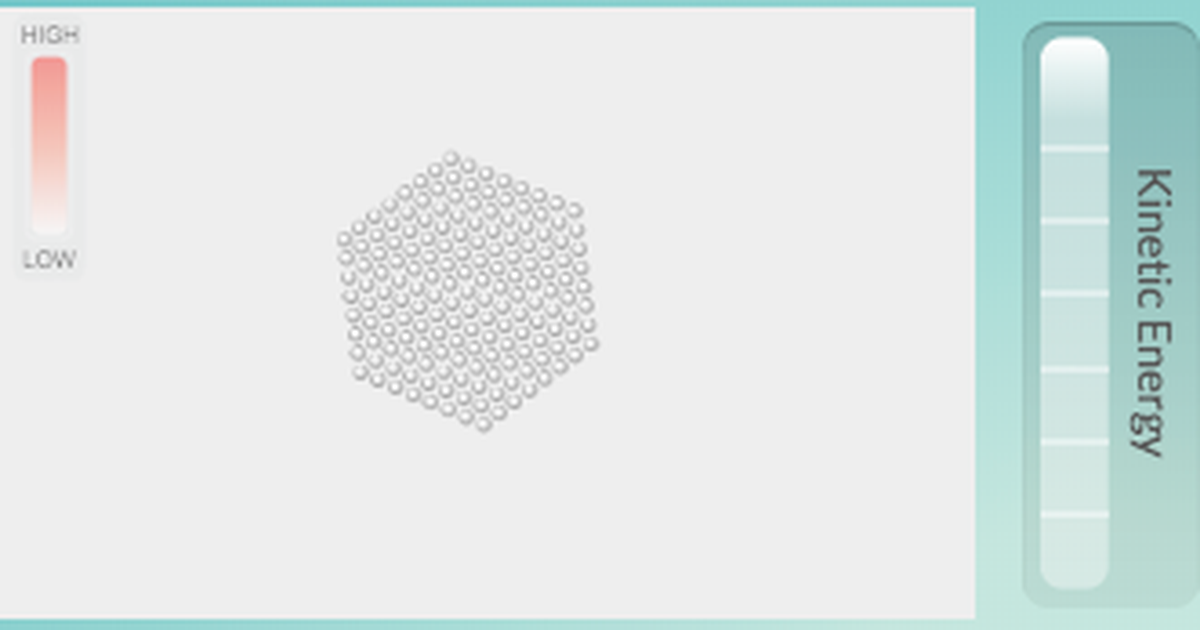
Specific heat capacity is the measure of the heat energy required to raise the temperature of a given quantity of a substance by one kelvin. Latent heat of melting describes the amount of heat required to melt a solid. When a solid is undergoing melting, the temperature basically remains constant until the entire solid is molten. The above simulation demonstrates the specific heat and the latent heat. The physical origin of latent heat is that when a system is in a phase transition, its structure will change. Changing structure usually results in changes of potential energy, because potential energy depends primarily on structure. In the simulation, the energy added to the system is absorbed by the atoms and used to break the interatomic interactions (so that they can leave the condensed state). During the phase transition the kinetic energy doesn't increase, as the potential energy increases in the expense of the input energy. During this period, the interatomic interactions diminish and the structure breaks up, resulting in a phase transition. One thing you would notice is that the temperature-energy curve on the right has fluctuations. This is because we have much fewer atoms (169) in the simulation than there would be in a real physical model.
Topics
- Specific Heat Capacitly
- Latent Heat
- Kinetic Energy
- Potential Energy
- Phase Change
- Melting