Autosomal Modes of Inheritance
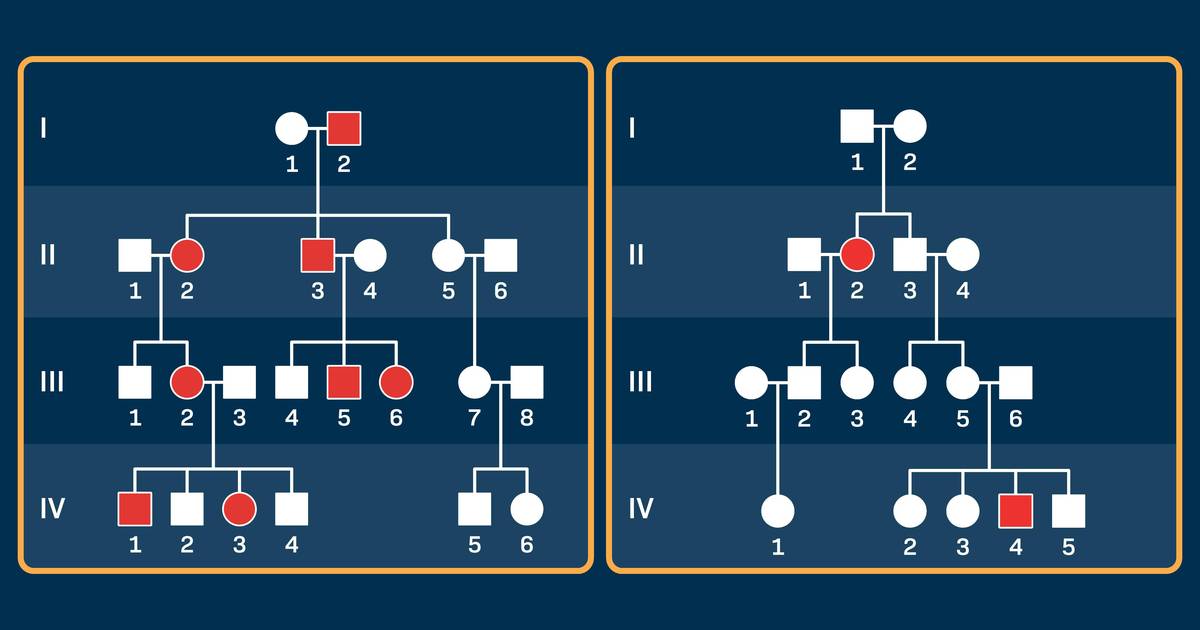
Traits or conditions that are determined by genes that are located on autosomes (nonsex chromosomes) follow an autosomal mode of inheritance. There are 2 autosomal modes of inheritance: autosomal dominant and autosomal recessive. Learn about the key characteristics of pedigrees that show these modes of inheritance in this scrollable interactive.
Topics
- 3:1
- achondroplasia
- affected
- affected female
- affected individual
- affected male
- allele
- autosomal
- autosomal dominant
- autosomal recessive
- autosome
- biological parent
- carrier
- children
- chromosome
- condition
- cystic fibrosis
- dominant
- equal frequency
- familial hypercholesterolemia
- family history
- female
- female child
- gene
- generation
- genetic condition
- genetic trait
- genotypic ratio
- heterozygous
- homozygous
- Huntington’s disease
- inheritance
- male
- male child
- mating
- Mendelian inheritance
- mode of inheritance
- monohybrid cross
- nonsex chromosome
- oculocutaneous albinism
- offspring
- pedigree
- phenotype
- phenylketonuria
- polydactyly
- recessive
- sickle cell anemia
- Tay-Sachs disease
- trait
- unaffected
- unaffected child
- unaffected female
- unaffected individual
- unaffected male