Biostatistician
Sample Subheading
Also known as: ["Biometrician", "biostatistical consultant", "biostatistician", "statistical scientist"]
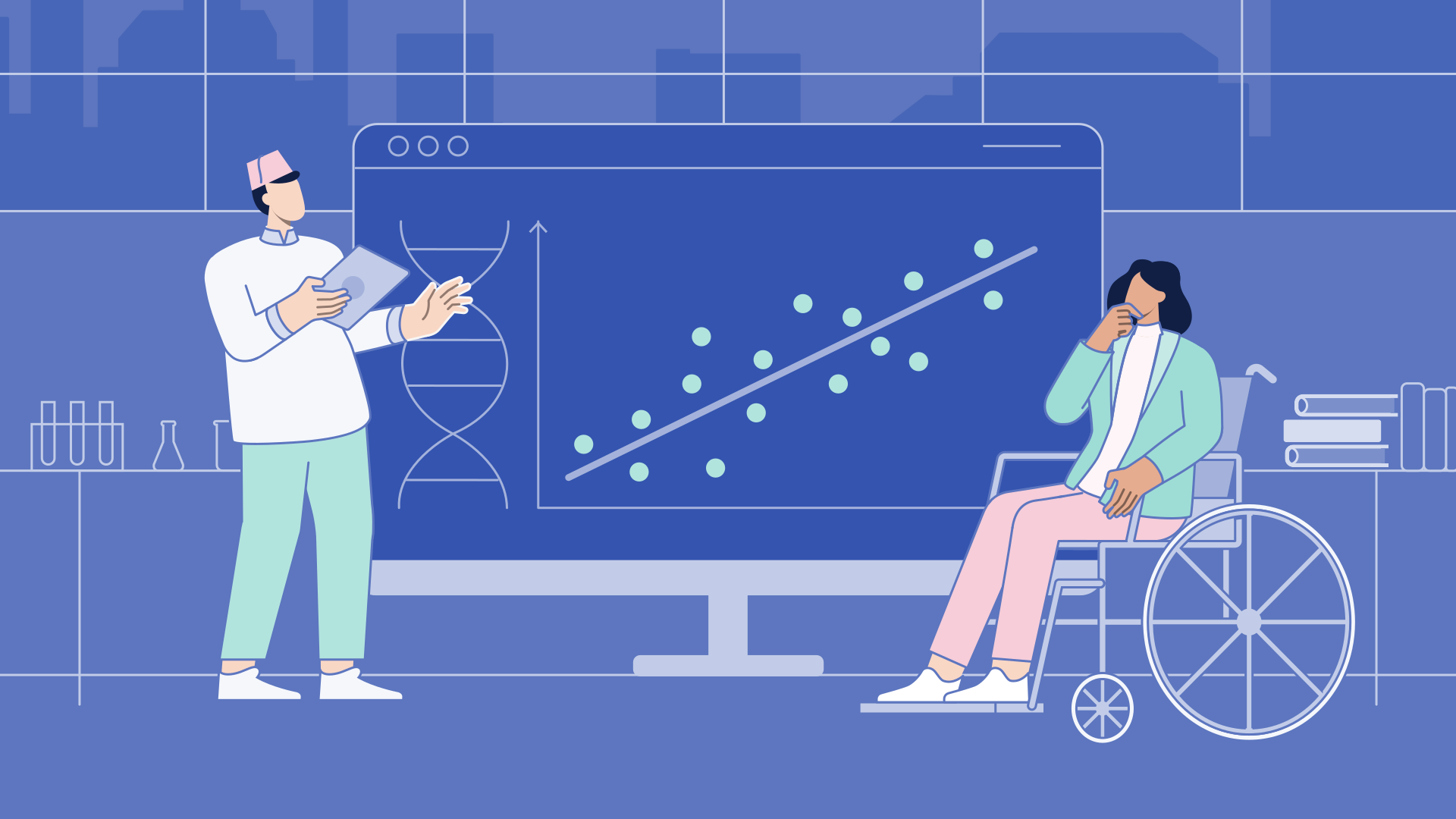
Biostatisticians are the data detectives of the life sciences, uncovering patterns and making sense of complex biological data. They develop and apply mathematical models to study everything from disease spread to treatment outcomes, helping scientists and healthcare professionals make evidence-based decisions that save lives.
Duties
- Apply statistical techniques Work with clinical, survey, or experimental data using advanced methods like logistic regression and longitudinal analysis. You’ll help shape research by choosing the best approach for the question at hand.
- Interpret data trends Use statistical models to analyze biological data and uncover trends that inform public health or medical decisions. You’ll translate complex numbers into clear findings that scientists and doctors can act on.
- Write research reports Create detailed analysis plans and clearly communicate your results through technical reports or scientific articles. You’ll turn data into decisions for researchers and health professionals.
- Plan study designs Calculate how many participants are needed to make a study reliable and statistically sound. You’ll support valid conclusions and ensure research is ethically conducted.
- Stay updated on methods Keep up with the latest developments in biostatistics, life sciences, and healthcare by reviewing literature, attending conferences, and collaborating with experts. You’ll bring cutting-edge methods into real-world research.
Education
Minimum qualification: Master’s degree
Biostatistician
A mindmap-style diagram shows both typical and alternative pathways to enter into this role. It maps out different education and career steps, with routes that intersect. Select each step in the diagram to learn more.
Salary
- Entry level: 111000
- Mid level: 133000
- Senior level: 154000
Job outlook
Job openings: 2300
Demand: Rapid growth
- More data means more need for experts who can analyze and explain it clearly. (The global bioinformatics market will hit $45.7B by 2030 (CAGR 13.4%).)
- Tailored treatments rely on strong stats to prove they work safely and effectively. (Precision medicine market to reach $175.6B by 2030, CAGR 11.5%.)
- Public health projects need biostatisticians to model outbreaks and analyze trends. (Biostatistician roles projected to grow 28% from 2022–2032.)
Quote
Even if you don't know what you want for a career now, it is important to learn so that you are prepared when the opportunity hits upon you.
Jing Ma, PhD, Biostatistician, and Assistant Professor at Fred Hutchinson Cancer Center
Read Jing Ma's story
Jing Ma analyzes massive datasets from over 30,000 dogs across America to understand how we age. As a biostatistician on the Dog Aging Project, she discovered that feeding dogs once daily leads to better health outcomes and mapped how disease networks change as dogs grow older. She grew up on a farm in rural China as a first-generation college student, using math as her pathway from village life to becoming a research scientist at Fred Hutch Cancer Center.
Related careers
Sources
, Boston University School of Public Health. (2021). Scarlett Bellamy, ScD. , Bureau of Labor Statistics, U.S. Department of Labor. (2025, August 28). Occupational outlook handbook: Mathematicians and statisticians. U.S. Department of Labor. , Grand View Research. (2025). Bioinformatics market size, share & growth report, 2030. , Massachusetts Department of Elementary and Secondary Education. (2024). Massachusetts curriculum frameworks. , Precedence Research. (2025, April 5). Precision medicine market size.