Probability: How Can We Use Evidence to Reason about Chances?
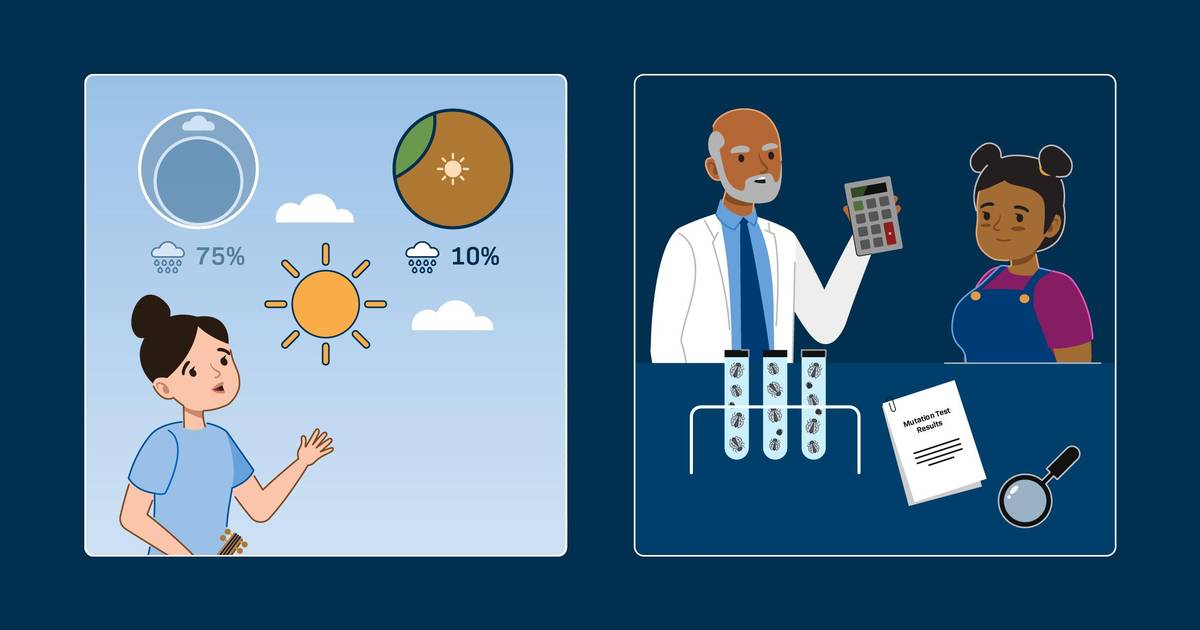
This pathway will deepen your understanding of how evidence can help us to reason accurately about chances and uncertainty. Using visualizations and relatable examples from everyday life, you’ll explore foundational probability concepts, like independence, conditional probability, and base rates. By learning to identify and avoid common mistakes, such as the gambler’s fallacy and conjunction fallacy, you’ll enhance your ability to reason critically. Finally, you’ll practice applying these insights to realistic contexts, from assessing health risks to interpreting the reliability of test results, helping you to make better-informed decisions about probability.
Topics
- accuracy rate
- adding probabilities
- application
- argument
- base rate
- base rate neglect
- bias
- calculating probabilities
- calculation
- chance
- chance of illness
- chess tournament
- cognitive bias
- coin flips
- combination of probabilities
- Complement Rule
- conditional probability
- conditions
- confidence
- confirmation bias
- conjunction
- conjunction fallacy
- Conjunction Rule
- conjuncts
- co-occurring events
- decrease probability
- dependent events
- dependent probabilities
- detecting plagiarism
- detection
- detection system
- diagrams
- disconfirming evidence
- events
- evidence
- eyewitness identification
- fair coin
- fallacies
- false negative rate
- false positive rate
- frequency of an event
- gambler’s fallacy
- high school
- impossible outcomes
- improbable streaks
- increase probability
- independence
- independent events
- independent probabilities
- intersection
- likelihood
- marble draws
- marbles
- mathematics of probability
- medical testing
- multiple events
- mutually exclusive events
- odds
- outcomes
- overlapping possibilities
- overlapping probabilities
- possible outcomes
- probability
- probability claim
- probability distribution
- probability of an event
- probability rules
- probability theory
- Product Rule
- proportion of possible outcomes
- random streaks
- reasoning
- resetting probabilities
- rolling dice
- scientific reasoning
- reasoning about probabilities
- sequence of events
- success stories
- Sum Rule
- symbolizing probabilities
- threat assessment
- test accuracy
- unconditional probability
- visualization
- visualization tool
- visualizing overlapping probabilities
- visualizing probabilities
- visualizing probability rules
- weather outcomes
- weighted coin
- winning a contest